
Most people try to reach 10,000 steps by relying on motivation.
They plan walks.
They set reminders.
They tell themselves they’ll “make time later.”
It works for a few days.
Then life gets busy — and walking disappears.
The problem isn’t effort.
It’s that walking isn’t built into your environment.
A more sustainable approach is to make walking automatic by attaching it to things you already do.
Why Motivation Isn’t Enough
Motivation is unreliable.
It fluctuates with:
- energy
- schedule
- stress
- sleep
That’s why even strong intentions break down over time.
Research on habit formation shows that behaviors are far more likely to stick when they’re tied to consistent cues in your environment — not just willpower.¹
If walking depends on “finding time,” it will always compete with everything else.
If walking is triggered automatically, it happens without needing a decision.
What Are Environmental Triggers?
Environmental triggers are cues that prompt a behavior without conscious effort.
Instead of asking:
👉 “When should I go for a walk?”
You shift to:
👉 “When this happens, I walk.”
Examples:
- After a meeting → walk for 5 minutes
- After dinner → take a short walk
- Before your first coffee → get steps in
- During phone calls → walk instead of sitting
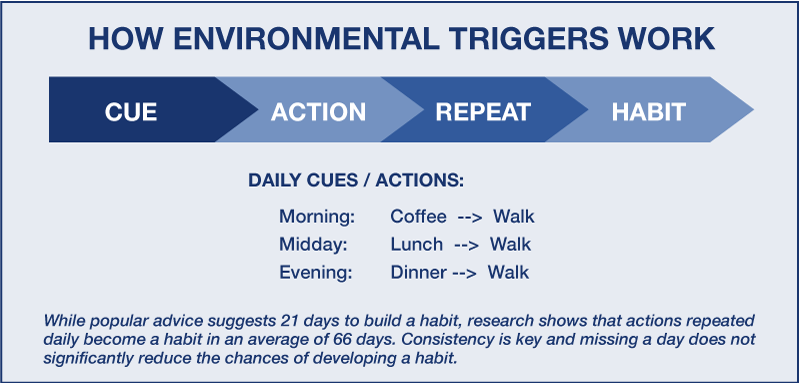
These small triggers remove friction and make walking repeatable.
Why This Works for 10,000 Steps
Reaching 10,000 steps isn’t about one long walk.
It’s about accumulating movement across the day.
That’s why this strategy pairs naturally with:
- spreading steps throughout the day (→ see Strategy 2: Spread Steps Throughout the Day)
- walking for purpose (→ see Strategy 5: Walk for Utility, Not Just Exercise)
Instead of relying on a single block of time, you build steps into your existing routine.
How to Set Up Walking Triggers
Start simple.
Choose 2–3 moments in your day that already happen consistently.
Then attach a small walking action to each.
Step 1: Identify Anchors
Look for things you already do daily:
- meals
- meetings
- coffee breaks
- phone calls
- transitions between tasks
Step 2: Attach a Walking Action
Keep it small and realistic:
- “After lunch → walk 5–10 minutes”
- “Every phone call → stand or walk”
- “After work → walk around the block”
The goal isn’t intensity — it’s consistency.
Step 3: Remove Friction
Make walking the easiest option:
- Keep shoes accessible
- choose easy routes
- avoid needing to “get ready”
- eliminate setup time
The less friction, the more automatic the behavior becomes.
Example: A Day Built on Triggers
Here’s what this can look like in practice:
- Morning: short walk after coffee → 1,000 steps
- Midday: walk after lunch → 2,000 steps
- Afternoon: walking meetings or calls → 2,000–3,000 steps
- Evening: short walk after dinner → 2,000 steps
Without a dedicated workout, you’re already near or at 10,000.
This is how walking becomes part of your day — not something you have to “fit in.”
Triggers vs. Daily Targets
Rigid targets create pressure.
Triggers create momentum.
If you miss one walk, the next trigger is still there.
This is why combining triggers with a flexible baseline works well:
👉 See Strategy 4: Use a Minimum Step Floor
Instead of chasing perfection, you build a system that keeps you moving.
Common Mistakes to Avoid
1. Starting too big
If your triggers require too much effort, they won’t stick.
Start small.
2. Relying on memory
Triggers should feel automatic — not something you have to remember.
Tie them to strong, consistent cues.
3. Overloading your day
2–3 triggers are enough to start.
You can always add more later.
The Bigger Shift
This strategy changes how you think about walking.
Instead of:
👉 “I need to find time to walk”
It becomes:
👉 “Walking happens when my day happens”
That shift is what makes consistency possible.
How This Fits Into the Bigger System
Environmental triggers are one piece of a larger approach to sustainable walking.
If you haven’t yet, read:
👉 The Ultimate Guide to 10,000 Steps a Day
It explains how all of these strategies work together — and how to make them fit your life.
Final Takeaway
You don’t need more motivation to reach 10,000 steps.
You need fewer decisions.
When walking is tied to your environment, it stops being something you have to think about — and starts being something you just do.
Citations
- Lally et al., 2010 — How habits are formed: Modelling habit formation in the real world
- Wood & Neal, 2007 — A new look at habits and the habit-goal interface