For many people, the idea of walking 10,000 steps a day comes with an unspoken assumption:
It has to happen in one long walk.
Usually at the end of the day.
Usually when energy is lowest.
Usually when it’s easiest to skip.
When that walk doesn’t happen, the entire day feels like a failure — even if you were active in smaller ways. This is one of the biggest reasons people struggle to stay consistent with daily step goals.
The good news is simple:
10,000 steps doesn’t need to happen all at once to be effective.
In fact, spreading your steps throughout the day often makes the goal easier to reach — and easier to maintain.
The “One Big Walk” Assumption
Most people picture 10,000 steps as a single, dedicated walking session. It feels logical: set aside time, go for a walk, get it done.
But in practice, this approach is fragile.
A long walk:
- Competes with work, family, and energy levels
- Requires motivation at a specific time
- Is easy to postpone — and then skip entirely
When walking is treated as one large commitment, missing it feels like missing everything. That all-or-nothing pressure is what causes many people to abandon the goal altogether. Our hack is simple – we’ll treat it as a series of small, easy commitments. No pressure, no overwhelm.
For a broader explanation of where the 10,000-step goal comes from, what the research actually says, and how to approach it realistically, see the Ultimate Guide to 10,000 Steps a Day.
Why Step Distribution Matters More Than Total Time
Here’s the shift that changes everything:
Steps are cumulative.
Your body doesn’t care whether those steps happened in one hour or spread across the day. What matters is total movement and how often you break up sedentary time.
Spreading steps out:
- Lowers the effort required at any one moment
- Makes walking feel lighter and more approachable
- Removes the pressure to “find time” later
Instead of asking, “When will I go for a long walk?”
You start asking, “Where can I add a few minutes of movement?”
That difference is subtle — and powerful.
The Science Behind Frequent, Short Walks
You don’t need to dive deep into studies to understand why this works.
Frequent movement throughout the day:
- Reduces long periods of sitting
- Supports better blood sugar regulation, especially after meals
- Lowers fatigue compared to one long session
- Reduces injury risk from overuse
Short walks are also easier to repeat — and repeatability is the foundation of habit formation. Short walks are easy and unintimidating.
This is one reason spreading steps aligns so well with long-term consistency: it works with your energy instead of against it.
What “Spreading Your Steps” Actually Looks Like
Spreading steps doesn’t mean constant movement or tracking every minute.
It usually looks like:
- 5–10 minute walks
- Natural transitions between tasks
- Light, comfortable movement
- No pressure to walk fast
Make walking easier by building it into things you’re already doing. Common examples include:
- A short walk in the morning
- Walking during phone calls
- A few minutes of movement after meals
- A brief walk to decompress in the evening
- Go up and down stairs an extra trip
- Quick shopping trips
- Quick walk to get the mail
Individually, these don’t feel like much. Together, they add up quickly. This approach works best when you first redesign your day around steps, instead of treating walking as a workout you have to squeeze in later.
A Realistic Example of Step Distribution
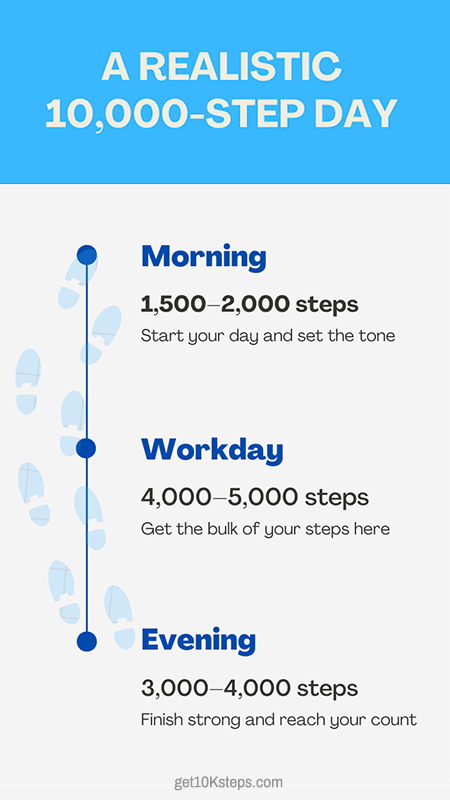
Here’s what a typical day might look like when steps are spread out:
- Morning: 1,500–2,000 steps
- Workday: 4,000–5,000 steps
- Evening: 3,000–4,000 steps
No single walk needs to be long.
No single moment carries the entire burden.
This is why the goal feels lighter when steps are distributed — you’re never starting from zero late in the day.
On especially busy days, a minimum step floor can ensure the habit stays intact even if your total falls short of 10,000.
Common Mistakes When Trying to Spread Steps
A few patterns tend to get in the way:
- Waiting for motivation instead of relying on routine
- Ignoring short walks because they “don’t count”
- Trying to spread steps perfectly across every hour
- Treating missed movement as failure
Spreading steps isn’t about precision. It’s about reducing friction.
Even an imperfect distribution is far more sustainable than relying on one ideal walk.
How This Strategy Supports Long-Term Consistency
When steps are spread out:
- Missed moments matter less
- Busy days feel more manageable
- Walking becomes part of normal life
- Consistency improves naturally
This approach pairs especially well with redesigning your day around steps, rather than treating walking as a workout you have to fit in later.
It also sets the stage for other strategies, like setting a minimum step floor or tracking progress over time.
How This Fits Into the Bigger Picture
Spreading steps throughout the day isn’t a standalone trick — it’s part of a larger system.
- It supports redesigning your day for more steps
- It makes tracking progress feel less stressful
- It turns walking into a background habit instead of a chore
This is one of the reasons it shows up repeatedly in sustainable walking routines.
🎯 The Takeaway
You don’t need one perfect walk to reach 10,000 steps.
You need movement that fits naturally into your day.
When steps are spread out, walking becomes easier to start, easier to repeat, and easier to sustain.
Once step distribution clicks, consistency stops feeling forced – and momentum builds on its own.