Most people don’t miss 10,000 steps because they’re lazy — they miss it because the goal is framed in a way that doesn’t fit real life. The hardest part of walking 10,000 steps a day isn’t the walking. It’s figuring out where it’s supposed to fit.
You start the day with good intentions. You plan to go for a walk later. But by the time work wraps up, energy is low, motivation is gone, and the idea of “fitting in a workout” feels unrealistic. So the steps don’t happen — and the cycle repeats.
But here is the good news: You probably don’t need more time to reach 10,000 steps. You need a different approach.
The most reliable way to make daily walking stick isn’t by adding another task to your schedule. It’s by redesigning your day so movement is built in, not bolted on.
If you’re new here, the Start Here page explains how Get 10K Steps approaches walking, consistency, and building a sustainable daily routine.
Why “Finding Time to Walk” Is the Wrong Problem
When people struggle to reach 10,000 steps, they usually blame time.
“I don’t have an extra hour.”
“My schedule is too packed.”
“I’ll start once things slow down.”
But for most adults, time isn’t the real issue. Placement is.
Walking is often treated like a workout — something that has to be planned, scheduled, and completed in one clean block. When that block doesn’t happen, the day feels like a failure, even if you were active in smaller ways. Even worse, when you stack multiple days of this, your entire effort can be derailed.
This creates a few common traps:
- All-or-nothing thinking (“If I can’t do a full walk, why bother?”)
- End-of-day guilt
- Inconsistent routines that rely on motivation
- Feelings of failure lead you to drop your routine entirely
The problem isn’t that walking takes too much time.
It’s that walking is competing with the rest of your life instead of blending into it.
Once walking is framed as “extra,” it’s usually the first thing to get cut.
The Shift That Makes 10,000 Steps Realistic
The turning point for most people is realizing this:
10,000 steps works best when treated as a background behavior, not a scheduled event.
Walking doesn’t need to feel like exercise to be effective. It can be:
- Transitional
- Purpose-driven
- Light
- Spread out
Instead of asking, “When will I go for a walk?”
The better question is:
“Where can walking replace sitting?”
This shift changes everything.
When steps are woven into moments that already exist — phone calls, transitions, breaks, short errands — they stop feeling optional. They become part of how your day naturally flows.
And once walking stops competing with your schedule, consistency becomes much easier.
In the next section, we’ll map out how your current day already supports more steps than you think — before changing anything at all.
Map Your Current Day (Before Changing Anything)
Before trying to walk more, it helps to see what your day already looks like.
Not the ideal version.
Not the “healthy” version.
The real one.
Most people underestimate how much opportunity for movement already exists in their daily routine. Mapping your current day isn’t about judgment or optimization yet — it’s about awareness.
Start by breaking your day into three simple parts.
Morning
Think about the first hour or two after you wake up.
Ask yourself:
- Do you move at all before sitting down?
- How much of your morning is spent seated?
- Are there natural transitions (getting ready, commuting, dropping kids off) where movement already happens?
For many people, mornings include small bursts of movement — walking to the bathroom, kitchen, car, or train — but they end quickly once the day “starts.” Even a short 5–10 minute walk in this window can meaningfully change your step total before noon.
Don’t change anything yet. Just notice.
Work Hours
This is where most steps quietly disappear.
Whether you work in an office, from home, or in a hybrid setup, the pattern is often the same:
- Long seated blocks
- Minimal transitions
- Breaks that involve screens, not movement
Ask yourself:
- How long do you typically sit without standing?
- Do phone calls keep you seated by default?
- Are breaks intentional, or reactive?
Most workdays contain dozens of short transition moments — calls, task switches, mental breaks — that currently happen while sitting. Each one is a potential walking opportunity later on.
Again, no fixing yet. Just observe.
Evening
Evenings often feel like the only “available” time for walking — which is why so many people place all their expectations here.
Ask yourself:
- What does the transition out of work look like?
- Is there a natural pause between work and the rest of the evening?
- How do you usually unwind?
Evenings tend to be either:
- Too busy (family, chores, obligations), or
- Too low-energy (fatigue, decision overload)
That’s why relying on evenings alone to hit 10,000 steps can feel fragile. When energy is low, walking is often the first thing skipped.
What You’re Looking For
As you map your day, you’re not searching for long walking windows.
You’re looking for:
- Repeated sitting patterns
- Automatic behaviors
- Transition points that already exist
These are the easiest places to insert steps later — because they don’t require more time, just a different choice.
Once you can see where your day is already rigid and where it’s flexible, redesigning it becomes much simpler.
In the next section, we’ll walk through specific, high-impact places to insert steps into your day — without adding a single new commitment.
For a complete breakdown of where the 10,000-step goal comes from, what the research actually says, and how to approach it realistically, see the Ultimate Guide to 10,000 Steps a Day.
6 High-Impact Places to Insert Steps Into Your Day
Once you can see where your day is naturally rigid and where it’s flexible, the next step is simple: replace sitting with light movement in a few key places.
You don’t need to do all of these. One or two changes is often enough to shift your daily step count meaningfully.
1. Walking Calls and Meetings
Phone calls are one of the easiest times to add steps without changing your schedule.
If you don’t need to be on camera or take notes, stand up and walk. A 10–15 minute call can add 1,000–1,500 steps with almost no effort. If you work remotely, even internal meetings can become walking meetings when cameras are optional.
Many of us have multiple calls during a workday. Consider batching two calls to stretch your walk time up to 30 minutes and double your potential step count. Alternatively, spread your calls throughout the workday and add the steps gradually over multiple walk-and-talk sessions.
2. A Morning Step Anchor
A short walk early in the day removes pressure later.
This doesn’t need to be long or intense. Ten minutes around the block, walking the dog, or pacing while listening to a podcast is enough.
Starting the day with movement:
- Builds early momentum
- Reduces decision fatigue
- Makes the rest of the day feel easier
3. Post-Meal Walks
Walking after meals is one of the most underrated habits for both health and consistency.
A 5–10 minute walk after lunch or dinner:
- Adds steps effortlessly
- Supports digestion
- Helps regulate blood sugar
These walks don’t need to look like exercise. A slow lap around the block or even indoor walking counts.
4. Commute and Transition Walking
Transitions are hidden step opportunities.
Examples:
- Parking farther away
- Getting off public transit one stop early
- Taking a short walk between work tasks instead of sitting
These small choices add up over the course of the day without feeling like extra work.
5. Replace Scroll Breaks With Short Walks
Most breaks already exist — they’re just spent sitting.
The next time you reach for your phone during a break, try standing up and walking instead. Even a few minutes around your home or office adds meaningful steps.
You’re not removing rest. You’re just changing how it looks.
6. An Evening Decompression Walk
An easy walk at the end of the day helps close the mental loop of work and stress.
This isn’t about hitting a number. It’s about:
- Clearing your head
- Reducing stress
- Supporting sleep
For many people, this walk becomes one of the most enjoyable parts of the day.
What a “Redesigned” Day Actually Looks Like
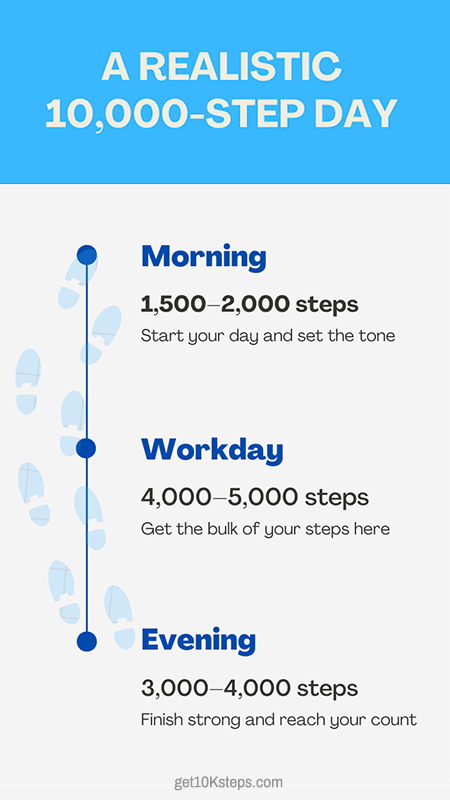
When steps are spread out, no single walk has to do all the work.
A realistic example might look like this:
- Morning movement: 1,500–2,000 steps
- Workday movement: 4,000–5,000 steps
- Evening movement: 3,000–4,000 steps
None of these requires long workouts or perfect conditions. They rely on consistent placement, not intensity.
This is why redesigning your day works — it removes the pressure to be perfect.
This becomes much easier once you make your steps visible and measurable, which helps you adjust earlier in the day instead of guessing at night.
Why This Works Better Than One Big Walk
Relying on a single long walk at the end of the day is fragile.
Spreading steps throughout the day:
- Reduces fatigue
- Lowers injury risk
- Improves adherence
- Makes walking feel lighter and more sustainable
It also aligns better with how habits actually form. Frequent, low-effort actions are far easier to repeat than one large commitment.
One of the reasons this approach works so well is that steps don’t need to happen all at once — spreading your steps throughout the day makes 10,000 steps far easier to maintain.
Common Mistakes When Redesigning Your Day
A few things tend to trip people up:
- Trying to change everything at once
- Waiting for ideal conditions
- Treating steps as punishment
- Ignoring recovery and comfort
If walking starts to feel forced or stressful, something needs to be simplified.
Consistency matters more than precision.
And if 10,000 steps still feels intimidating at first, using a minimum step floor can protect your consistency while you build momentum.
Start With One Change (Not a Full Overhaul)
The fastest way to make this stick is to start small.
Pick one place in your day where you can replace sitting with walking:
- One daily call
- One post-meal walk
- One short evening walk
Try it for a week before adding anything else.
Once that change feels automatic, build from there.
🎯 The Takeaway
You don’t need more time to walk 10,000 steps a day. The opportunities are already there. You need fewer barriers between movement and your life.
When walking fits naturally into your day, consistency stops being a struggle — and 10,000 steps stops feeling like a stretch goal.
Redesign your day first. The rest becomes simpler.